
Your everyday shipments
Parcels to send within France or Europe, at the pace of your business.
Parcel shipping
OVRSEA supports your parcel shipments in France and worldwide. Expert teams and a simple interface help you organise everything from one-off shipments to regular flows.
Talk to an expert
At your pace
Whether you send a few parcels occasionally or manage large volumes every week, OVRSEA supports you with a solution that fits your organisation.
For both your occasional needs and your regular shipments.
To organise and support your shipments.
A clear interface to manage your parcels.
Your destinations
For domestic shipments, European trade and exports, our teams help you organise transport and the required documentation.
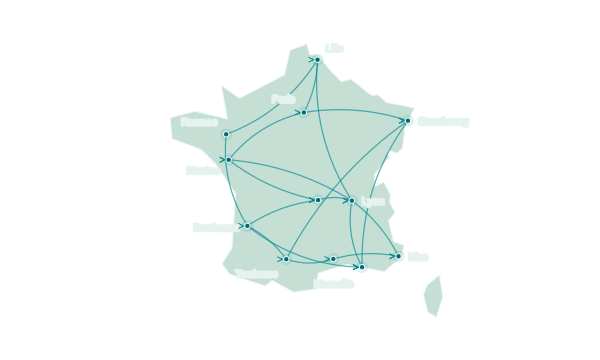
An occasional parcel or regular shipments: we support your transport needs within France.
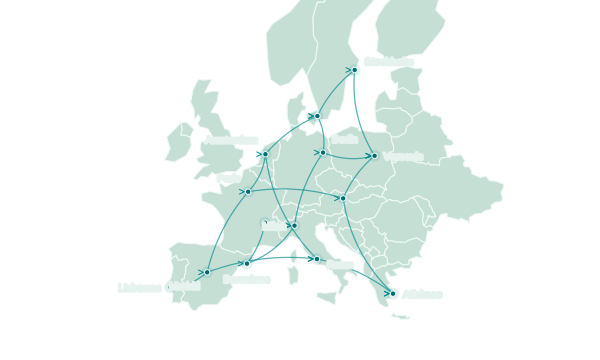
Organise parcel shipments within the European Union with support from our teams.
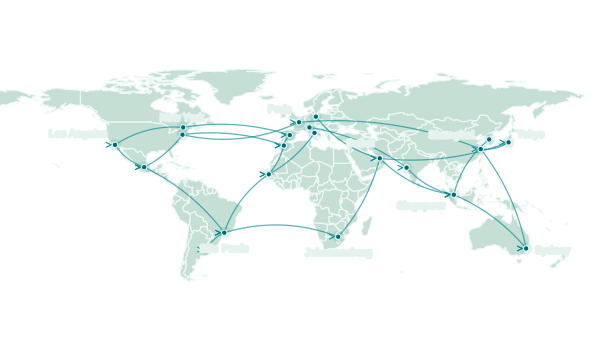
Rely on our experts to prepare your international shipments and the associated documentation.
Operational expertise
Need guidance with your first shipments, or already have specific requirements? Our teams organise your shipments and support you at every step.
Talk to an expertYour goods, destinations and organisation are our starting point.
Our teams help you arrange transport and prepare the necessary documents.
You can rely on our expertise throughout your shipment.
Everyday simplicity
Keep a clear view of your shipments in an easy-to-use interface, with support from our teams whenever you need it.
The freedom of an interface.
The support of a team.
Your needs, our expertise
Goods to deliver, documents to send, samples to collect from your suppliers: we support your company's different shipping needs.
Parcels to send within France or Europe, at the pace of your business.
Support with transport and the required documentation.
Certain perfumes or products containing batteries, handled according to their specific requirements.
Frequently asked questions
Customs, documents, transit times, restricted goods, rates and tracking: answers to the questions businesses most often ask when organising parcel shipments.
Three decisions shape the shipment. First, the transport mode: express air freight for urgent needs, road or consolidated freight when timing is less pressing. Next, the customs procedure: no export declaration is required within the European Union; outside the EU, an export declaration and a complete set of documents are mandatory. Finally, the allocation of costs, defined by the Incoterm, determines who pays for transport, insurance, duties and taxes. Poor documentation means a blocked parcel: customs holds the shipment until the missing documents arrive.
At OVRSEA, you do not make these decisions alone: our teams assess your needs, choose the transport mode, prepare the documents and manage the shipment through to delivery. You no longer have to find an available carrier at short notice or guess which documents customs requires.
An express carrier operates its own network and sells its own rates: it carries out the transport it has sold, on its routes and under its acceptance rules. A freight forwarder, acting as a French commissionnaire de transport, organises transport on behalf of the shipper: it selects providers, builds the transport plan, handles customs formalities and is liable for its subcontractors' errors. The former sells a standard service; the latter designs a solution and takes responsibility for the full chain.
OVRSEA is a freight forwarder: one contact for all your parcels, whichever carrier transports them. You no longer have to compare multiple rate cards, use several portals or work out who is responsible when something goes wrong.
The core documents are always the same: a commercial invoice (or pro forma invoice for a shipment without a sale), packing list, the HS code for each item in the customs tariff, declared value, the shipper's EORI number, the Incoterm and an export declaration. Some destinations or goods also require a certificate of origin, health certificate or export authorisation. Exports outside the EU are VAT-exempt provided proof of exit is retained.
Our teams prepare and check these documents before departure, then handle the customs declaration. You avoid shipments held at customs, invoices that need correcting afterwards and the resulting storage charges.
It depends on the agreed Incoterm. Under DAP, the recipient pays import duties and taxes before receiving the goods. Under DDP, the shipper bears all of them. By default, express carriers bill the recipient for duties and add a disbursement fee; if the recipient refuses to pay, the amount is charged back to the shipper. For a sample sent to a prospect or a part owed to a customer, unexpected charges on arrival can damage the commercial relationship.
We agree the Incoterm with you before shipment and explain what will be charged, to whom and when. You avoid unpleasant surprises for the recipient and unexpected charges for your accounts team.
Four factors matter, and transport alone rarely determines the timing. The chosen mode and frequency of departures to the destination. Import customs clearance, which can add days if a document is missing or the goods are inspected. The goods' acceptance rules: poorly prepared dangerous goods are refused at departure, costing more than a day in transit. Finally, last-mile delivery, whether to a business address, a warehouse requiring an appointment or a remote area. A lead time quoted without checking these four points is still an estimate.
We build the transport plan around your target date, including formalities, and alert you as soon as anything in the shipment file threatens the schedule. You no longer discover a hold-up by calling the recipient.
A shipment without a sale is still a commercial shipment for customs purposes. It requires a pro forma invoice with a declared value and the customary statement "value for customs purposes only, no commercial value", an HS code and the reason for shipment. If the equipment must return, such as a prototype, demonstration unit or trade show stand, a temporary customs procedure such as an ATA carnet or temporary admission avoids duties on the outward and return journeys, provided you can prove it returns unchanged.
Samples, replenishment orders and spare parts are the shipments where timing matters most and documentation is most often overlooked. We handle both, so your parcel leaves on the day you planned.
Yes, subject to conditions, never automatically. Alcohol-based perfumes are Class 3 dangerous goods: flammable liquids. Lithium batteries fall under Class 9, with different rules depending on whether they travel inside equipment, with it or separately. When shipped separately, they are restricted to cargo aircraft and a reduced state of charge. In every case, approved packaging, marking, dangerous goods documentation and acceptance by the chosen carrier must be checked before booking. An undeclared shipment is refused at departure, and the shipper remains responsible.
We handle these shipments when the conditions are met and tell you clearly when they are not. You avoid refusal at departure, parcels held at a depot and the search for a carrier willing to accept the goods.
A carrier's liability is limited by weight, rather than the value of the goods. International conventions, Montreal for air transport and CMR for road, set compensation per kilogram. For a light, high-value parcel, such as a luxury sample or electronic component, that compensation covers only a fraction of the loss. Only ad valorem insurance, taken out on the actual declared value before departure, covers the goods for what they are worth.
We assess cover alongside transport and alert you when the parcel's value makes the legal liability limit inadequate. You make an informed decision before a loss occurs.
There are three levers, in order. Consolidation: shipments spread across several carriers do not create a negotiable volume, whereas the same flows grouped with a freight forwarder benefit from the volumes it negotiates for all its customers. Packaging: the price is based on chargeable weight, the greater of actual and volumetric weight, so a box that is too large means paying to ship empty space. Finally, the right transport mode: paying for express when a shipment could wait is still the most common unnecessary cost.
We apply negotiated volume rates to your small shipments and suggest the right mode for each one. You no longer need to negotiate rate cards yourself on volumes too small to carry weight.
This is the most common source of friction: each carrier has its own portal, status labels and notifications, and no one has an overall view. Tracking is then pieced together manually through follow-ups, and information arrives after the problem. Consolidation means bringing events from all carriers into one tool, with the shipment documents in the same place.
On the OVRSEA platform, your parcels and the rest of your freight are tracked in one place, alongside each shipment's documents. You stop chasing information across multiple portals and contacts.
Yes, and it changes how you manage transport. Parcels are often handled separately by other providers, under their own contracts and invoices, leaving them outside the overall transport picture. Bringing parcels and ocean, air or road freight together with one freight forwarder gives you one contact, one invoicing process and a consolidated view of all flows, urgent and regular.
OVRSEA organises your parcel shipments in France, Europe and worldwide alongside the rest of your transport. You reduce the number of providers to manage and regain a complete view of your flows.
Let's take stock
Discover how OVRSEA can make managing your parcels easier.