

What is an Incoterm?
When a customer and a supplier in two countries around the world conclude a contract, then the question arises of the transport of the goods, which will involve risks and costs: At what point are they transferred to the buyer? Incoterms were invented to answer this question.
Incoterms were created in 1936 in Paris to provide a universal answer to these questions. They make it possible to avoid any misunderstandings related to language barriers, national legal references and customs. They clearly set out the obligations of the buyer and the seller.
Their role is to clarify these four topics:
- Precisely locate the transfer of risks from the seller to the buyer during the transport of the goods.
- Determine who subscribes to the main transport contract (air or sea for example).
- Distribute logistical and administrative costs throughout the transport.
- Specify the obligations of each person for the completion of export and import customs formalities.
However, the Incoterms do not concern the transfer of ownership, which is still governed by the law governing the contract. Incoterms are not mandatory and they give way to any contrary stipulation.
The choice of Incoterm is made during commercial negotiations. It depends on many factors, for example:
- Means of transport
- Knowledge of the international transport of the buyer and the seller
- Wish to provide a more or less complete service on the part of the seller or the buyer
- Market practices
- Political, economic and geographical situation of the countries where the goods transit
Incoterms are abbreviations of three letters, followed by a place of destination, which is either that of delivery or the place to which transport is taken care of.
Being familiar with Incoterms is essential during an international transaction.
Details of the 11 types of Incoterms
There are 11 Incoterms that distribute the load according to the table below.
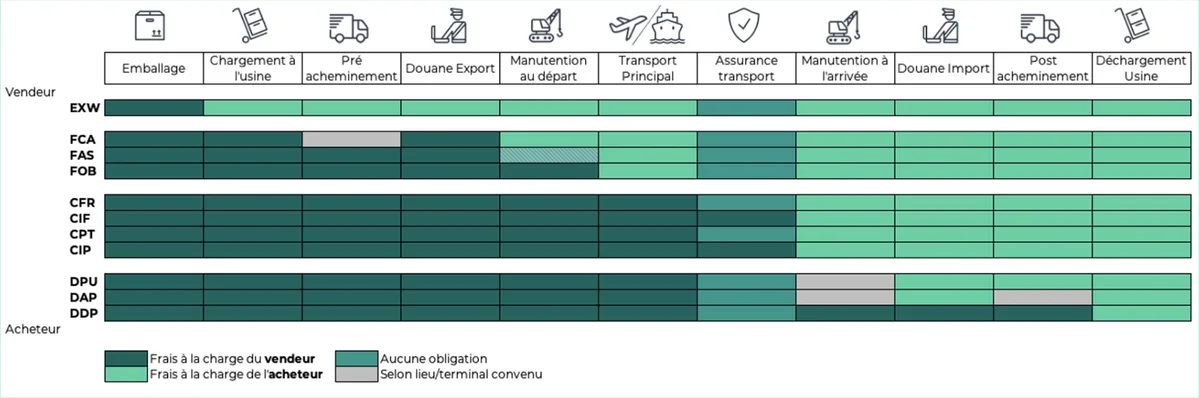
Here is an incoterm by incoterm detail.
EXW: Ex Works/Ex-works
Vendor
- Make the goods available to the buyer on their premises, packaged and marked
Buyer
- Pick up the goods at the seller's premises
- Transport the goods at their own expense and risk
- Customs clearance for export and import
FCA: agreed delivery place (Free Carrier/Franco-Transporter)
Vendor
- Deliver the goods (packed and marked) to the point agreed with the carrier appointed by the buyer
- Export customs
- Prove the delivery of the goods to the carrier
Buyer
- Designate the main carrier
- Pay the freight
There is a variant: Seller's local FCA
This Incoterm was formalized by the 2000 revision of the Incoterms: it is then up to the seller to load the goods.
FCA is more suitable than FOB in transporting goods in containers
FAS: agreed port of embarkation (Free Alongside Ship/Franco along the ship)
Vendor
- Deliver the goods (packed and marked) along the ship to the shipping company designated by the buyer
- Export customs
- Prove the delivery of the goods to the carrier
Buyer
- Designate the main carrier
- Sign the transport contract and pay the freight
- Bear all risks as soon as the goods are delivered alongside the ship
FOB: agreed port of embarkation (Free on Board/Loaded on board)
Vendor
- Deliver the goods (packed and marked) to the agreed port of departure
- Export customs
- Prove the delivery of the goods to the carrier
- Pay the loading fees
Buyer
- Designate the main carrier (shipping company)
- Sign the transport contract and pay the freight
CFR: agreed port of destination (Cost and Freight/Cost and Freight)
Vendor
- Deliver the goods (packed and marked) to the agreed port of departure
- Export customs
- Prove the delivery of the goods to the carrier
- Pay the loading fees
- Sign the transport contract and pay the freight
- Bear the costs of unloading upon arrival if they are included in the transport price
Buyer
- Receive the goods at the agreed port
- Pay unloading fees if they are not included in the freight
CIF: agreed port of destination (Cost Insurance Freight/Cost Insurance Freight)
Vendor
- Deliver the goods (packed and marked) to the agreed port of departure
- Export customs
- Prove the delivery of the goods to the carrier
- Pay the loading fees
- Sign the transport contract and pay the freight
- Bear the costs of unloading upon arrival if they are included in the transport price
- Take out a minimum insurance coverage for the goods at your own expense during the entire transport
Buyer
- Receive the goods at the agreed port
- Pay unloading fees if they are not included in the freight
CPT: agreed place of destination (Carriage Paid To/Port Paid Up to)
Vendor
- Deliver the goods (packed and marked) to the agreed port of departure
- Export customs
- Prove the delivery of the goods to the carrier
- Pay the loading fees
- Sign the transport contract and pay the freight
- Bear the costs of unloading upon arrival if they are included in the transport price
- Take out a minimum insurance coverage for the goods at your own expense during the entire transport
Buyer
- Receive the goods at the agreed port
- Pay unloading fees if they are not included in the freight
CIP: agreed place of destination (Carriage and Insurance Paid To/Port Paid Insurance Included Up to)
Vendor
- Deliver the goods (packed and marked) to the agreed port of departure
- Export customs
- Prove the delivery of the goods to the carrier
- Pay the loading fees
- Sign the transport contract and pay the freight
- Bear the costs of unloading upon arrival if they are included in the transport price
Buyer
- Receive the goods at the agreed port
- Bear the costs of unloading upon arrival if they are not included in the transport price
DAT: Terminal Agreed (Delivered At Terminal)
Vendor
- Deliver the goods (packed and marked) to the agreed port of destination and pay the unloading costs
- Export customs
- Provide the documents to the buyer allowing him to pick up the goods at the terminal
Buyer
- Receive the goods at the agreed port
- Customs clearance at import
DAP: agreed place (Delivered At Place/Rendered at the place of destination)
Vendor
- Deliver the goods (packed and marked) to the agreed port of destination and pay the unloading costs
- Export customs
- Provide the documents to the buyer allowing him to pick up the goods at the agreed location
- Bear the costs of unloading upon arrival if they are included in the transport price
Buyer
- Receiving the goods at the agreed place of destination
- Customs clearance at import
- Bear the costs of unloading upon arrival if they are not included in the transport price
DDP: agreed place of destination (Delivered Duty Paid)
Vendor
- Deliver the goods (packed and marked) to the agreed port of destination and pay the unloading costs
- Customs clearance for export and import
- Provide the documents to the buyer allowing him to pick up the goods at the agreed location
- Bear the costs of unloading upon arrival if they are included in the transport price
Buyer
- Receiving the goods at the agreed place of destination
- Bear the costs of unloading upon arrival if they are not included in the transport price
Ovrsea offers you a personalized service for any Incoterm. For more information, go to www.ovrsea.com.